
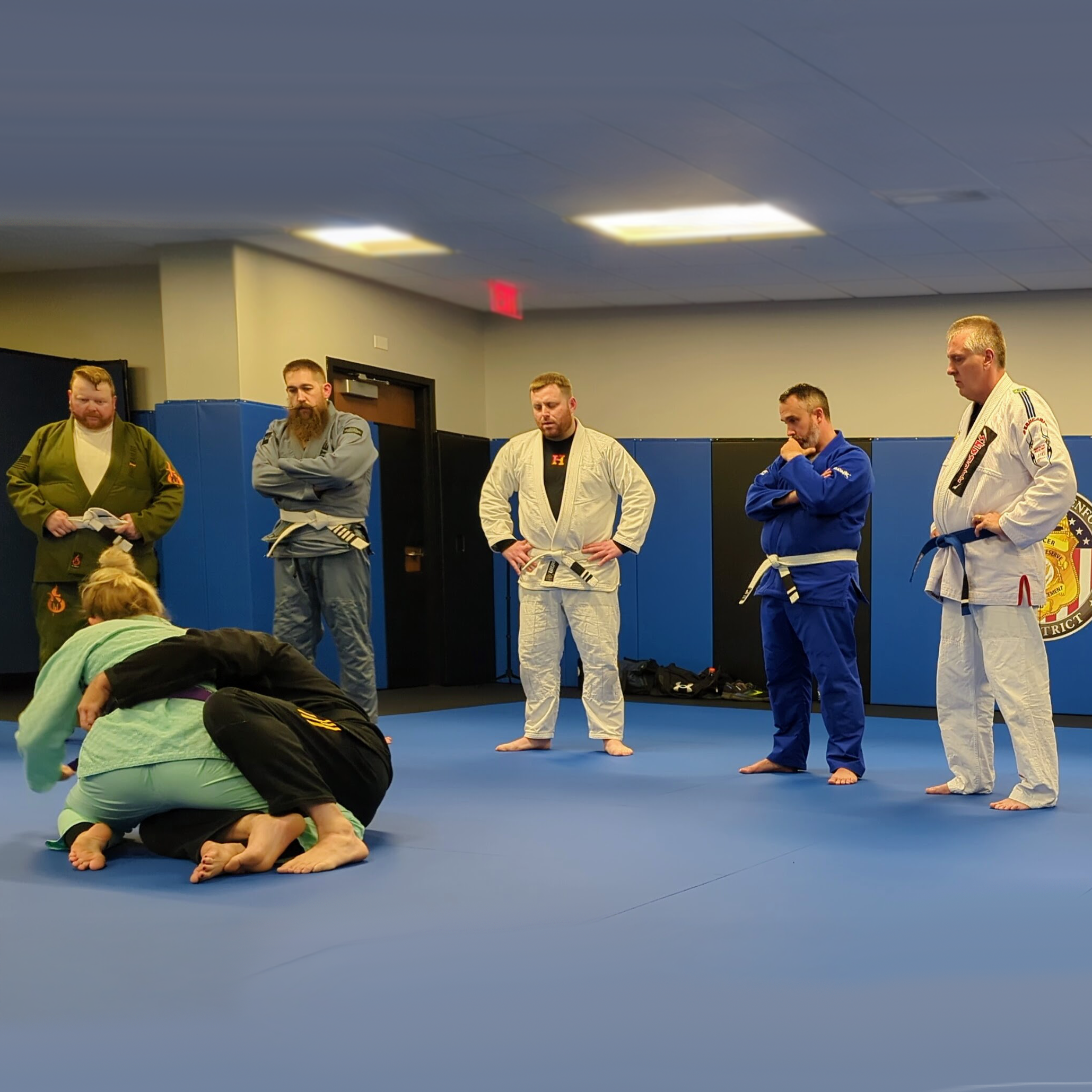
Attending your first jiu-jitsu class? You probably have some questions and the FLEOA 111 Project has answers. Well, not all of them, but this guide should help.
Attire
If this is your first class, it’s unlikely you have the training apparel unique to jiu-jitsu, such as rash guards, spats, or a gi. It’s all good; you can wear gym clothes. Contrary to the ridiculous things seen on the Internet, plan to wear a shirt with sleeves that fully cover the shoulders down to the waistline. Do not wear tank tops, plunging necklines, or crop tops. If wearing shorts, do an L-sit by lying on your back with legs extended upwards, making an L with the body. If the shorts fall down enough to expose things that should remain private, wear mid-thigh briefs or leggings underneath the shorts. These standards apply to both men and women.
Shoes are not to be worn on the mat. This is to keep the mats sterile. Training barefoot is preferred, but socks are also appropriate. Most students wear flip-flops or sandals to class, which are efficient when going on and off the mat. It is also wise to leave jewelry and watches at home because they are prohibited during training, and valuables are usually more secure at home than in the gym. Men, some may prefer to wear cups/groin protection, but it is not required. Ladies, sports bras are strongly recommended but not required.
Preparation
Drink plenty of water and plan to arrive early. Make sure your body and your clothes are freshly cleaned. Many prefer to shower before class, while others just wipe their feet off and wash their hands. Many also like to brush their teeth, rinse with mouthwash, or use a breath freshener before class. Do not chew gum while training; it can fall out and land on someone’s face or hair.
Upon Arrival
When you arrive, “check your ego” to ensure you have the best class experience. This phrase is used to describe the process of acknowledging that you will have very little skill at the beginning stage of jiu-jitsu, arriving with no expectations of your performance, accepting that jiu-jitsu takes many years to master, and understanding that those students with only a few months of training will be considerably better than you.
Introduce yourself to the instructor and prepare to sign a waiver of liability. Offer to pay the drop-in fee or ask to begin a free trial if one is advertised. If needed, use the restroom one final time before removing your shoes. Observe other students as they step onto the mats. Did they bow? If so, follow their lead and bow. If not, just step on the mat. Did we mention never step onto the mat with your shoes on? That’s an important rule for student safety because shoes transfer fungi, viruses, and bacteria onto the mats – the same mats with bare skin touching them during class.
Once on the mat, begin stretching. Some schools will begin class with a warm-up, others don’t. It’s best practice to stretch and warm yourself up, just in case. If you’re feeling social, this is the appropriate time to introduce yourself to nearby students.
Beginning Class
Many classes begin with a “line-up” by forming a line of students in order of rank. Observe which end of the line the white belts and/or beginners move toward, and stand at the very end of that side of the line. If nobody is wearing a gi, no biggie, the best guess is to stand on the far right of the line as you face the line-up.
Most classes involve a lesson and sparring (“rolling”). Some classes have a warm-up, some have drilling, and some will partner you up immediately for an activity. Regardless, just follow along. If you’re partnering, don’t be surprised if you’re not selected. This isn’t high school, and nobody is judging you. Jiu-jitsu can be familial at best, tribal at worst, so many partner with those most familiar to them. Someone will pick you up. Just be patient.
During Class
The lesson is the part of the class when the coach or professor teaches a technique. Be attentive and quiet during the lesson. Stand up and position yourself where you can see the essential details of the technique being taught. After being taught a technique and allowed to practice it on your own, do your best to replicate it with your partner, but don’t be discouraged when, not if, you make mistakes. Corrections will be made by coaches so, when corrected, thank the coach for the correction and implement their advice. When a student is performing the technique on you, don’t resist. You need to allow them to succeed so they can learn. On the other hand, don’t be a “wet noodle,” floppy and limp, because that makes it difficult for your partner to practice a technique. This is a skill in itself, so in the meantime, ask your partner if you’re giving the “right energy.” They’ll tell you.
When it’s time to roll, it is recommended that you observe at first; however, if you want the full experience, jump in if the coach allows. It is proper etiquette to ask a higher-ranking belt if they would like to roll, and since everyone outranks you on day one, find a partner and ask them to “work with you.” Rolling is not competition; it is an activity wherein each partner tries to best the other using technique, and can be a spirited test of a student’s skill. Begin and end every rolling session with a handshake, fist bump, or “high five” to show respect and signify the beginning and end of the roll, accompanied by verbal gratitude.
After Class
Many classes that begin with a line-up will end similarly. After class, thank the coach and any partners who worked with you. If you have questions about the class, now is the time to ask.
…And that’s it
You completed your first jiu-jitsu class. We recommend that anyone beginning jiu-jitsu attend a minimum of four classes before making any judgments on jiu-jitsu, either good or bad, so the student can make an educated decision on their continued involvement. Questions? Hit us up on social media at the links below.
About The Author
Brian Bowers is a Brazilian Jiu-Jitsu black belt under Professor Chris Popdan with 15 years of experience and the Lead instructor of the FLEOA 111 Project. Read More….
Discover more from
The FLEOA 111 Project
Subscribe to our free newsletter to be notified of new articles, events, literature reviews, and other information related to our mission. You do not need to be a member of FLEOA to participate in the FLEOA 111 Project.
Follow The FLEOA 111 Project on social media
 The FLEOA 111 Project
You must be logged in to post a comment.